Laser technology has transformed the field of urology, enabling surgeons to perform minimally invasive procedures with exceptional precision, safety, and efficiency. From kidney stone treatment to soft tissue surgeries, laser systems have become an essential part of modern urological practice. Among the leading technologies, Thulium Fiber Laser and Holmium Laser have emerged as the most widely used solutions.
While the Holmium Laser has long been considered the gold standard for lithotripsy and endourological procedures, the emergence of the Thulium Fiber Laser has introduced a new level of innovation. Urologists worldwide are increasingly adopting this advanced technology for its superior performance and enhanced patient outcomes.
In this Post, we will explore the key advantages of Thulium Fiber Laser over Holmium Laser in urology, helping healthcare professionals understand why this next-generation laser system is rapidly gaining popularity.
Understanding Thulium Fiber Laser and Holmium Laser
What is Thulium Fiber Laser?
The Thulium Fiber Laser is a cutting-edge laser system designed specifically for urological applications. It utilizes a thulium-doped fiber as its gain medium, allowing precise energy delivery at a wavelength highly absorbed by water.
This characteristic makes the Thulium Fiber Laser exceptionally effective for stone fragmentation, dusting, and soft tissue applications.
What is Holmium Laser?
The Holmium Laser has been a trusted tool in urology for decades. It operates using a solid-state crystal and delivers pulsed energy that effectively fragments urinary stones and treats soft tissue conditions.
Although highly effective, the Holmium Laser has certain limitations when compared to newer technologies.
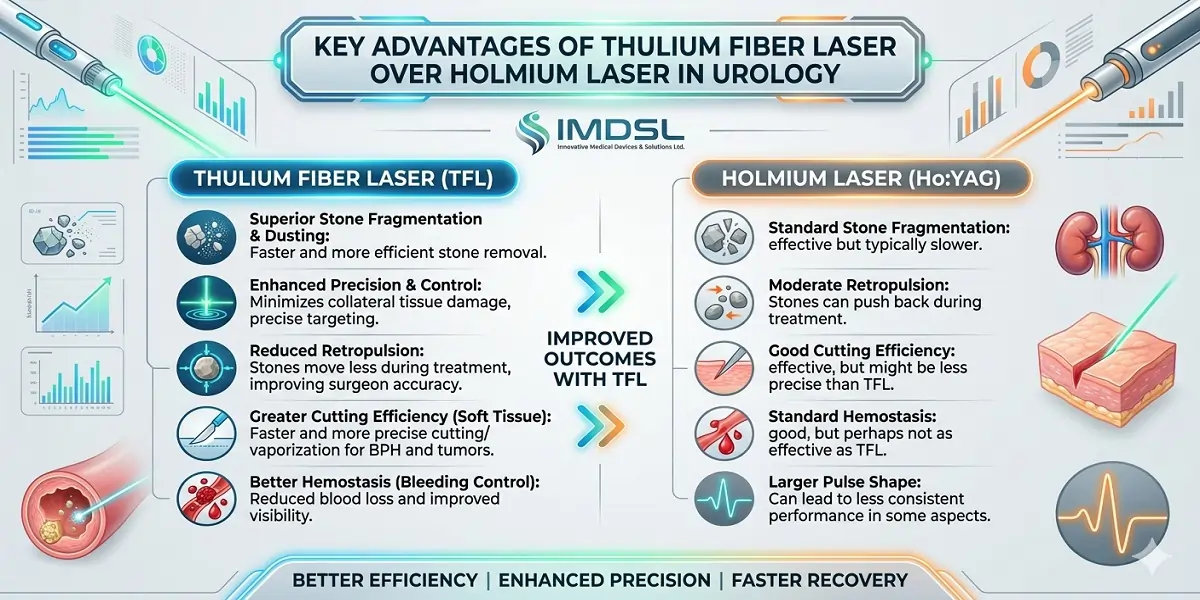
Key Advantages of Thulium Fiber Laser Over Holmium Laser
Superior Stone Ablation Efficiency
One of the biggest advantages of the Thulium Fiber Laser is its remarkable stone ablation speed. Compared to the Holmium Laser, it can break down stones faster and more efficiently.
Faster Fragmentation
The smaller pulse energy and higher frequency of the Thulium Fiber Laser allow rapid stone vaporization, creating finer dust particles.
Reduced Procedure Time
Because of its superior efficiency, the Thulium Fiber Laser significantly shortens surgical time, benefiting both surgeons and patients.
Minimal Retropulsion During Lithotripsy
Stone retropulsion can complicate procedures by causing stone migration.
The Thulium Fiber Laser produces significantly less retropulsion than the Holmium Laser, ensuring better stone stability throughout treatment.
Enhanced Surgical Precision
Reduced stone movement allows precise targeting and improved control.
Better Stone Management
Surgeons can complete procedures more effectively with fewer interruptions.
Smaller Fiber Diameter
A major advantage of the Thulium Fiber Laser is its compatibility with ultra-thin laser fibers.
Unlike the Holmium Laser, which typically requires larger fibers, the Thulium Fiber Laser can operate efficiently with fibers as small as 50–150 microns.
Improved Scope Deflection
Smaller fibers enhance ureteroscope flexibility.
Better Access
This allows surgeons to reach challenging anatomical locations more easily.
Higher Frequency and Lower Pulse Energy
The Thulium Fiber Laser operates at frequencies up to 2400 Hz, far exceeding the capabilities of the Holmium Laser.
Efficient Dusting
Higher frequency enables superior dusting performance.
Smoother Procedures
Lower pulse energy minimizes tissue trauma and improves control.
Reduced Heat Generation
Safety is a top priority in urological procedures.
The Thulium Fiber Laser generates less heat than the Holmium Laser, reducing the risk of thermal injury.
Improved Patient Safety
Lower temperatures help protect surrounding tissues.
Enhanced Clinical Confidence
Surgeons can perform longer procedures with greater peace of mind.
Clinical Applications of Thulium Fiber Laser in Urology
Kidney Stone Treatment
The Thulium Fiber Laser is highly effective for renal calculi of all compositions.
Ureteral Stones
Its low retropulsion makes it ideal for ureteroscopic lithotripsy.
Bladder Stones
Efficient dusting enables rapid stone clearance.
Soft Tissue Procedures
The Thulium Fiber Laser is also effective for soft tissue incision and ablation.
Thulium Fiber Laser vs Holmium Laser: Comparative Analysis
Performance
The Thulium Fiber Laser consistently demonstrates faster stone ablation than the Holmium Laser.
Precision
Smaller fibers and lower retropulsion provide superior control.
Efficiency
Procedures are generally shorter with the Thulium Fiber Laser.
Safety
Reduced heat and improved targeting enhance overall patient safety.
Why Urologists Prefer Thulium Fiber Laser
Enhanced Surgical Outcomes
Better fragmentation and minimal retropulsion improve procedural success.
Increased Efficiency
Shorter operating times increase productivity.
Improved Patient Recovery
Patients often experience less trauma and faster recovery.
Cost Benefits
Although initial investment may vary, the Thulium Fiber Laser often delivers excellent long-term ROI.
Choosing the Right Laser System for Your Practice
Clinical Requirements
Evaluate the types of procedures performed most frequently.
Technology Goals
Consider future-proofing your practice.
Return on Investment
Assess maintenance, consumables, and productivity gains.
For practices focused on advanced stone management, the Thulium Fiber Laser offers substantial advantages over the Holmium Laser.
Vikrant Thulium Fiber Laser: A Smart Choice for Urologists
The Vikrant system represents the latest advancement in Thulium Fiber Laser technology.
Advanced Features
- High-frequency performance
- Exceptional dusting capability
- Ultra-thin fiber compatibility
- Minimal retropulsion
Clinical Excellence
The Vikrant Thulium Fiber Laser is engineered to deliver superior outcomes across a wide range of urological procedures.
Trusted Performance
Leading urologists trust Vikrant for precision, reliability, and efficiency.
The Future of Urological Laser Technology
The transition from Holmium Laser to Thulium Fiber Laser is accelerating across hospitals and specialty clinics worldwide.
With its unmatched performance, safety profile, and procedural efficiency, the Thulium Fiber Laser is redefining modern endourology.
As technology continues to evolve, it is poised to become the new gold standard.
Conclusion
The Thulium Fiber Laser offers numerous advantages over the traditional Holmium Laser in urology. From faster stone ablation and reduced retropulsion to improved scope deflection and enhanced patient safety, its benefits are substantial.
For urologists seeking cutting-edge technology, superior clinical outcomes, and greater procedural efficiency, the Thulium Fiber Laser is the clear choice.
Investing in advanced systems like Vikrant ensures your practice remains at the forefront of modern urological care.
Frequently Asked Questions
Is Thulium-Fiber Laser better than Holmium Laser?
Yes, the Thulium-Fiber Laser offers faster stone ablation, less retropulsion, and greater efficiency.
Can Thulium-iber Laser replace Holmium Laser?
In many applications, the Thulium Fiber Laser is increasingly replacing the Holmium Laser.
Which laser is better for kidney stones?
The Thulium Fiber Laser is widely considered superior for stone dusting and fragmentation.
Is Thulium-Fiber Laser safe?
Yes, it offers excellent safety with reduced thermal effects.
Why choose Vikrant Thulium-Fiber Laser?
Vikrant combines innovation, precision, and clinical reliability for outstanding urological outcomes.